
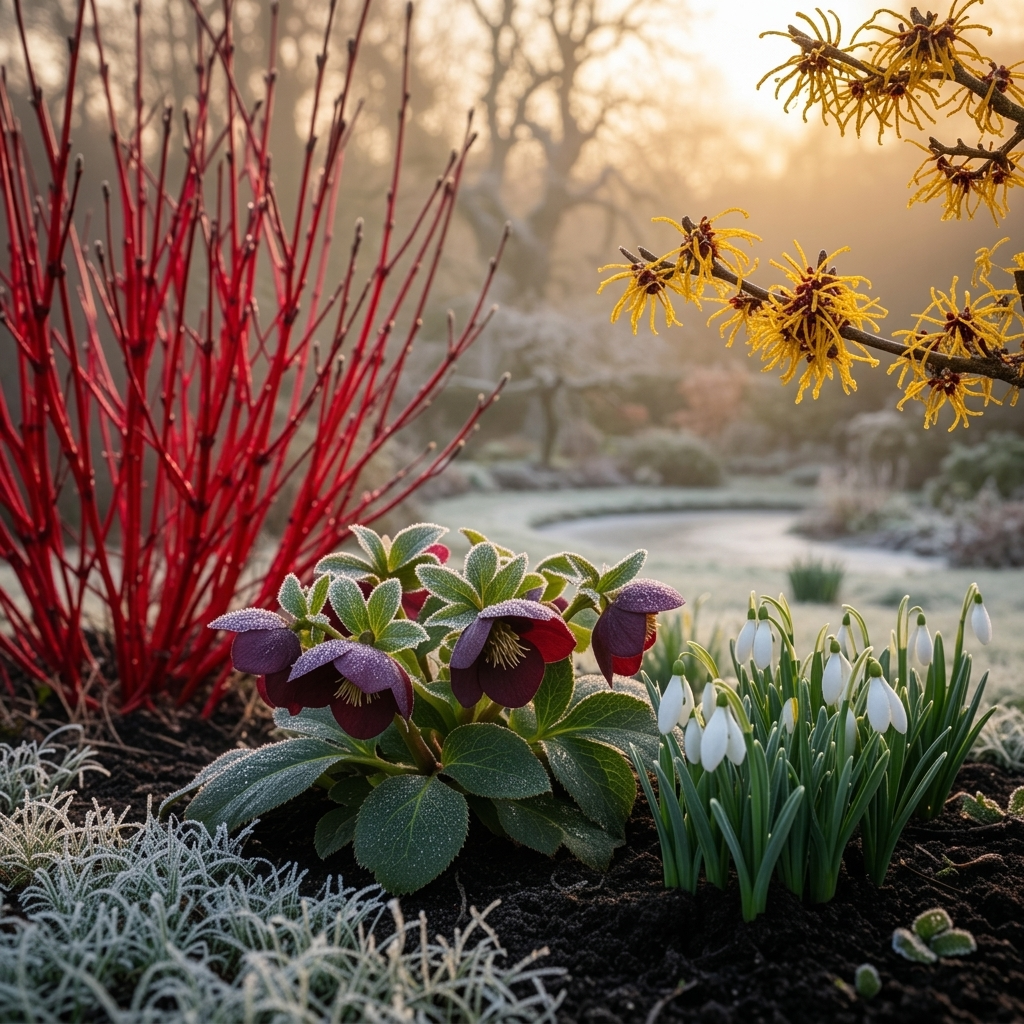
Who says the garden has to be dull in winter? Discover twelve beautiful plants that can transform your Hungarian garden into a place of colour, fragrance, wildlife and quiet beauty — even during the coldest months of the year.
There is a moment every winter when we look out of the window and wonder where all the colour has gone.
The roses have finished flowering.
The dahlias have disappeared beneath the soil or been carefully lifted and stored.
The trees have lost their leaves.
And the flower beds that were bursting with life only a few months ago suddenly seem rather empty.
Perhaps there is frost on the lawn.
Perhaps the sky is grey.
Or perhaps we are having one of those cold Hungarian December mornings when the garden looks as though it has decided to close for the season.
But has it really?
I don't think so.
In fact, I believe winter can be one of the most beautiful seasons in the garden.
Not because everything is flowering.
But because winter allows us to appreciate things that are sometimes hidden during the warmer months.
The elegant shape of a tree.
The deep green of evergreen leaves.
The beautiful red berries of a shrub.
The delicate fragrance of a flower opening on a cold January afternoon.
Or the extraordinary sight of a hellebore flowering while the rest of the garden is still sleeping.
Winter gardening is about discovering a different kind of beauty.
A quieter beauty.
One that rewards us for looking a little more closely.
And the wonderful thing is that we can plan for it.
With the right plants, even a small Hungarian garden can become an attractive place throughout December, January and February.
So today, let's take a little walk through the Christmas garden.
We'll meet twelve wonderful plants that can bring colour, fragrance, structure and interest to our outdoor spaces.
We'll discover where to plant them, how to care for them and which ones are especially suitable for Hungarian conditions.
And we'll explore how to combine them into a garden that remains beautiful long after the Christmas decorations have been packed away.
Make yourself a warm cup of tea, put on your gardening coat, and come into the garden with me.
Winter has more to offer than you might think.

1. The Christmas Rose — A Flower That Isn't Afraid of Winter
Botanical name: Helleborus niger
Hungarian name: Fekete hunyor
Main attraction: White winter flowers
Best position: Partial shade, sheltered from harsh conditions
<text>The flower that gives Christmas its own rose</text>
Let's begin with one of the most enchanting winter plants.
The Christmas rose.
Despite its name, it is not a rose at all.
It belongs to the hellebore family, and its botanical name is Helleborus niger.
This beautiful perennial produces elegant white flowers, often with golden-yellow centres.
As the flowers age, they may develop delicate pink or greenish tones.
In suitable conditions, Christmas roses can begin flowering during winter.
However, flowering time varies considerably with the weather, variety and location. In Hungarian gardens, blooms may appear from late winter into early spring rather than precisely at Christmas.
Why I love Christmas roses
There is something almost unbelievable about seeing a beautiful white flower opening during winter.
The surrounding garden may be brown and grey.
The soil may be cold.
And yet this little plant quietly produces flowers.
It is a wonderful reminder that nature doesn't completely stop during winter.
Where should you plant it?
Choose a position with partial shade.
A place beneath deciduous shrubs or trees can be ideal, provided the soil does not become excessively dry.
Christmas roses prefer fertile, humus-rich, well-drained soil and generally appreciate neutral to slightly alkaline conditions.
Avoid planting them in areas that remain waterlogged during winter.
Care in Hungary
In much of Hungary, established Christmas roses are hardy when planted in suitable conditions.
However, severe frost combined with exposed winds can damage flowers and foliage.
A sheltered position is helpful.
Apply a layer of leaf mould or compost around the plant, keeping the crown uncovered.
Avoid unnecessary disturbance once the plant is established.
Hellebores often dislike being moved.
GOOD TO KNOW
All parts of hellebores are toxic if eaten, and their sap can irritate skin.
Wear gloves when handling them and keep them away from children and pets that may chew plants.
2. Winter Jasmine — A Little Sunshine on Bare Branches
Botanical name: Jasminum nudiflorum
Hungarian name: Téli jázmin
Main attraction: Bright yellow flowers on bare stems
Best position: Sunny or lightly shaded, sheltered location
Imagine walking through the garden in January.
Most plants are still resting.
Then you notice something bright yellow against a wall.
Little star-shaped flowers.
And not just one or two.
Sometimes dozens.
This is winter jasmine.
It is one of the most cheerful winter-flowering shrubs we can grow.
Why is it so special?
Winter jasmine often produces flowers before its leaves appear.
Its long green stems can create a beautiful cascade of yellow flowers.
Against a dark wall or evergreen background, the effect is particularly striking.
Does it smell like jasmine?
Interestingly, winter jasmine is generally not fragrant.
Despite belonging to the jasmine genus, it doesn't have the powerful perfume associated with some other jasmine species.
Its beauty is primarily visual.
Where should you plant it?
Winter jasmine looks wonderful:
-
Against a garden wall.
-
Along a low fence.
-
Cascading over a retaining wall.
-
On a sunny slope.
-
Near an entrance where you can enjoy its winter flowers.
It can be trained against a support, although it does not climb by itself in the way that ivy does.
Care in Hungary
Winter jasmine is generally hardy in many Hungarian gardens.
Choose well-drained soil and avoid very exposed, frost-prone positions.
After flowering, prune older or untidy stems if necessary.
Because flowers develop on the previous season's growth, heavy pruning at the wrong time can reduce flowering.
A COMMON MISTAKE
Pruning winter jasmine heavily in autumn.
You may accidentally remove much of the growth that would have produced winter flowers.
Prune after flowering instead.

3. Witch Hazel — The Winter Shrub With Extraordinary Flowers
Botanical name: Hamamelis species and hybrids
Hungarian name: Varázsmogyoró
Main attraction: Ribbon-like winter flowers and fragrance
Best position: Sunny to lightly shaded, sheltered position
Now we come to one of my absolute favourites.
Witch hazel.
If you have never seen one flowering in winter, you are in for a treat.
Its flowers look almost as though someone has tied tiny ribbons to the bare branches.
Yellow ribbons.
Orange ribbons.
Sometimes coppery red ribbons.
And on certain varieties, the flowers release a beautiful fragrance.
Imagine walking through the garden on a mild February afternoon and suddenly noticing a delicate perfume in the cold air.
You look around.
There are no roses.
No lavender.
No summer flowers.
And then you discover the witch hazel.
When does it flower?
Depending on the species, cultivar and weather, witch hazels can flower from midwinter into early spring.
Some begin in January.
Others are more reliable in February or March.
Where should you plant it?
Witch hazel deserves a special position.
Plant it somewhere you can admire its winter flowers.
Near a pathway.
Beside a terrace.
Or where you can see it from the living-room window.
It generally prefers fertile, well-drained soil with an acidic to neutral reaction.
Important for Hungarian gardens
Many Hungarian gardens have alkaline or calcareous soils.
Witch hazel may struggle where soil pH is too high.
Before planting, check your soil conditions.
If your soil is strongly alkaline, consider choosing a more suitable plant rather than trying to change a large area of soil permanently.
Care
Witch hazels usually need little pruning.
Remove dead or damaged wood and avoid unnecessary cutting.
They grow relatively slowly, so give them enough room to develop their natural shape.
GOOD TO KNOW
Some witch hazel flowers can curl inward during very cold weather and reopen when temperatures rise.
It is a remarkable adaptation that helps protect delicate flower parts.

4. Winter-Flowering Viburnum — Fragrance When You Least Expect It
Botanical name: Viburnum × bodnantense
Hungarian name: Bodnanti bangita
Main attraction: Pink winter flowers and fragrance
Best position: Sunny to partially shaded, sheltered location
There are plants we grow for their colour.
Others for their leaves.
And then there are plants we grow because of their fragrance.
Winter-flowering viburnum belongs firmly in that last group.
During mild periods in winter, its bare branches can produce clusters of delicate pink flowers.
And the fragrance can be absolutely delightful.
A little winter surprise
Imagine walking past a seemingly ordinary shrub in January.
There are no leaves.
Nothing particularly exciting to see from a distance.
Then you notice a sweet scent.
You look closer.
And there, on the bare stems, are clusters of tiny pink flowers.
It is one of those small gardening moments that can make an entire winter day feel brighter.
Where should you plant it?
Near a path is ideal.
Or close to a frequently used garden entrance.
There is little point hiding a beautifully fragrant winter shrub in a far corner where nobody will notice it.
Care in Hungary
Choose a sheltered position with fertile, reasonably well-drained soil.
Flower buds may be damaged during severe frosts, so flowering can be interrupted.
However, established plants often produce flowers over an extended period during suitable weather.
Prune lightly after flowering if necessary.
A useful design idea
Plant winter-flowering viburnum near an evergreen shrub.
The dark green foliage behind it will make the pale pink flowers stand out beautifully.

5. Holly — The Traditional Christmas Evergreen
Botanical name: Ilex aquifolium and suitable cultivars
Hungarian name: Magyal
Main attraction: Evergreen foliage and colourful berries
Best position: Partial shade or suitable sheltered conditions
What would Christmas be without holly?
Its glossy leaves and bright red berries have become one of the most recognisable symbols of the festive season.
We see holly on Christmas cards.
In wreaths.
On festive table decorations.
And in traditional winter arrangements.
But holly is also a wonderful garden plant.
Why is holly so useful?
Because it provides structure and colour throughout winter.
When deciduous shrubs have lost their leaves, holly remains green.
Some varieties have beautifully variegated foliage.
Others produce attractive berries.
A little secret about holly berries
Many hollies are dioecious.
This means male and female flowers occur on separate plants.
Female plants generally need a compatible male pollinator nearby to produce berries.
However, some cultivars have different pollination requirements, so check the variety before buying.
If berries are your main goal, choose carefully.
Where should you plant it?
Holly generally prefers fertile, well-drained soil and a sheltered position.
It can tolerate some shade.
However, some varieties may struggle in strongly alkaline soils or exposed, drying winter winds.
Care in Hungary
Choose cultivars suited to local conditions.
Water young plants during dry periods while they establish.
Avoid excessive pruning if you want to preserve flower buds and berries.
Important safety note
Holly berries are not edible and can cause illness if swallowed.
Keep berry-bearing branches away from small children and pets that may eat them.
6. Skimmia — Beautiful Red Buds Throughout Winter
Botanical name: Skimmia japonica
Hungarian name: Japán dérbabér
Main attraction: Evergreen leaves and colourful winter flower buds
Best position: Partial shade, sheltered, acidic soil
Skimmia is one of those plants that deserves much more attention.
It is compact.
Evergreen.
Elegant.
And particularly attractive during winter.
Certain male cultivars develop clusters of reddish flower buds that remain decorative for months before opening into small flowers in spring.
Some female cultivars produce berries when pollinated.
Why is skimmia so useful?
Because it looks beautiful in containers.
If you have a small garden, terrace or balcony, skimmia can provide wonderful winter interest.
It also combines beautifully with hellebores and evergreen foliage.
Where should you grow it?
Skimmia prefers acidic, humus-rich soil.
This is especially important in Hungary, where many gardens have alkaline soil.
If your garden soil is unsuitable, growing skimmia in a container with an appropriate ericaceous compost may be easier.
Winter care
Protect container-grown plants from severe freezing of the root ball.
Keep the compost lightly moist but never waterlogged.
Avoid placing the pot in a location exposed to strong winter winds.
GOOD TO KNOW
The colourful red structures on many skimmias during winter are flower buds, not berries.
The actual flowers usually open in spring.
7. Firethorn — A Winter Feast of Colour
Botanical name: Pyracantha species and hybrids
Hungarian name: Tűztövis
Main attraction: Red, orange or yellow berries
Best position: Sunny to lightly shaded
Firethorn is one of the most useful shrubs for bringing colour into the winter garden.
Its branches can become covered with masses of colourful berries.
Bright red.
Orange.
Golden yellow.
Against its evergreen foliage, the effect can be spectacular.
Why do I recommend firethorn?
Because it offers several benefits.
It provides winter colour.
It can be trained against walls.
It forms dense hedges.
And its berries can provide food for birds.
A beautiful wildlife shrub
During autumn and winter, birds may visit firethorn to feed on the berries.
The dense, thorny branches can also provide shelter.
This makes it particularly useful in a wildlife-friendly garden.
Where should you plant it?
Firethorn generally performs best in a sunny or lightly shaded position.
It tolerates a range of soils, provided drainage is reasonable.
It is often suitable for Hungarian conditions, although cultivar hardiness and exposure should be considered.
Care
Prune carefully to maintain the desired shape.
Remember that heavy pruning can remove flowers and developing berries.
Wear gloves because the thorns are sharp.
A COMMON MISTAKE
Pruning a firethorn hedge so severely that nearly all the flowering shoots are removed.
The result may be a tidy hedge but very few winter berries.

8. Winter Heather — A Carpet of Colour in the Cold
Botanical name: Erica carnea
Hungarian name: Hússzínű erika
Main attraction: Pink, white or purple winter flowers
Best position: Sunny to lightly shaded, well-drained soil
When we think about winter flowers, we often imagine shrubs.
But some of the loveliest winter displays happen close to the ground.
Winter heath is a wonderful example.
This low-growing evergreen plant produces masses of small flowers, often from late winter into early spring.
Depending on the cultivar and weather, flowering can begin earlier.
Why is winter heath special?
Because it can create beautiful carpets of colour.
Pink flowers.
White flowers.
Purple flowers.
And fine evergreen foliage.
It is especially attractive when planted in groups.
Is it suitable for Hungary?
Yes, in suitable conditions.
One advantage of Erica carnea is that it generally tolerates more alkaline soil than many other heathers.
However, good drainage remains essential.
It dislikes waterlogged conditions.
Where should you plant it?
Winter heath looks lovely:
-
Along the front of flower beds.
-
In rock gardens.
-
Beside pathways.
-
On sunny slopes.
-
In containers with good drainage.
Care
Trim lightly after flowering to maintain a compact shape.
Avoid cutting deeply into old, leafless wood.
Water during prolonged dry periods, particularly while plants are establishing.
9. Dogwood — The Shrub That Becomes Beautiful After Losing Its Leaves
Botanical name: Cornus alba and related ornamental dogwoods
Hungarian name: Fehér som and other ornamental som species
Main attraction: Brilliant red, orange or yellow winter stems
Best position: Sunny to partially shaded
Now here is a plant that does something rather unusual.
It becomes more beautiful after its leaves fall.
Ornamental dogwoods are often grown for their colourful winter stems.
Some have brilliant red branches.
Others are orange, coral or golden yellow.
Against snow or a dark evergreen background, they look absolutely magnificent.
Why are the stems so colourful?
Young stems of certain dogwood cultivars contain pigments that create their striking winter colours.
The brightest colour is usually found on relatively young growth.
How do we keep them colourful?
Pruning is important.
Established plants can be rejuvenated by removing some older stems near the base in late winter or early spring.
Some gardeners use more extensive coppicing, but this should be done according to the species, cultivar and plant's condition.
Regular renewal encourages fresh, brightly coloured stems.
Where should you plant them?
Dogwoods look wonderful near:
-
Evergreen hedges.
-
Ponds.
-
Winter pathways.
-
Pale garden walls.
-
Ornamental grasses.
They often tolerate heavier soils better than many other ornamental shrubs, although preferences vary by species.
A little design secret
Plant several red-stemmed dogwoods together rather than one isolated shrub.
The effect is much stronger.
And if you combine red and yellow-stemmed varieties, you can create a wonderful winter colour display.

10. Mahonia — Winter Flowers With a Wonderful Fragrance
Botanical name: Mahonia × media and related species
Hungarian name: Mahónia
Main attraction: Yellow winter flowers and evergreen foliage
Best position: Sheltered partial shade
Mahonia is another plant that can surprise us during winter.
Its architectural evergreen leaves create structure throughout the year.
But certain species and hybrids also produce beautiful clusters of yellow flowers during the colder months.
Some have a delicate fragrance.
Why is mahonia so interesting?
Because it offers something quite unusual.
Bright yellow flowers against dark evergreen foliage.
During mild winter weather, these flowers may also attract insects that are active on warmer days.
Where should you plant it?
Choose a sheltered location.
Partial shade is often suitable.
Protect more tender varieties from severe winter winds and frost.
Is it hardy in Hungary?
Hardiness varies considerably between species and cultivars.
Some mahonias are suitable for many Hungarian gardens.
However, winter-flowering Mahonia × media cultivars can be vulnerable in colder or exposed locations.
Choose a sheltered microclimate and check the cultivar's hardiness before planting.
Care
Mahonia generally needs little pruning.
Remove damaged or unwanted stems after flowering if necessary.
Be careful when handling the prickly leaves.
11. Cotoneaster — Tiny Berries and Beautiful Winter Structure
Botanical name: Cotoneaster species and cultivars
Hungarian name: Madárbirs
Main attraction: Red berries, branching patterns and evergreen or semi-evergreen foliage
Best position: Sunny to partially shaded
Cotoneaster is one of those reliable plants that quietly does an enormous amount of work in the garden.
Some varieties spread close to the ground.
Others form larger shrubs.
Certain types retain their leaves through winter.
And many produce attractive red berries.
Why is cotoneaster so useful?
Because it can fill spaces where other plants struggle.
Low-growing varieties are excellent for slopes and the edges of flower beds.
Larger shrubs can provide winter structure and wildlife value.
The beauty of its branches
Even when leaves have fallen, some cotoneasters have wonderfully arranged branches.
The berries can make the plant look particularly attractive against frost or snow.
Care in Hungary
Many cotoneasters are adaptable and relatively easy to grow in well-drained soil.
However, hardiness and growth habits vary between species.
Choose a variety suited to your garden.
Some species can spread readily by seed, so consider local ecological guidance and avoid planting invasive types near natural habitats.
Wildlife value
The berries can provide food for birds.
The dense branches may also offer shelter.
A useful choice for gardeners who want a more wildlife-friendly winter garden.
12. Evergreen Conifers — The Backbone of the Christmas Garden
Botanical groups: Picea, Pinus, Juniperus and other suitable conifers
Hungarian names: Lucfenyő, erdeifenyő, boróka and others
Main attraction: Evergreen structure, colour and winter texture
Best position: Depends on species and cultivar
Let's finish our list with the plants that give the winter garden its structure.
Evergreen conifers.
Without them, many gardens would look rather empty during winter.
Conifers provide a permanent background.
They create height.
They offer shelter.
And they bring beautiful shades of green, blue-green, silver and gold into the garden.
Which conifers should we choose?
This depends on the size and conditions of your garden.
For smaller gardens, compact junipers and dwarf conifers can be excellent.
For larger gardens, carefully chosen pines or other suitable conifers can create a magnificent winter landscape.
A word of caution about Christmas trees
It is tempting to plant a small Christmas tree in the garden and imagine it remaining small forever.
But many conifers eventually become enormous trees.
Always check the mature size.
A plant that looks charming in a pot today may become far too large for a small garden in twenty years.
Care in Hungary
Hungarian summers can be hot and dry.
Some conifers, especially those adapted to cooler and moister climates, may struggle with prolonged heat and drought.
Choose species suited to your soil, available space and summer conditions.
Water newly planted conifers carefully during establishment.
And remember that evergreen plants continue losing moisture during winter.
They may need watering during prolonged dry, frost-free periods.
GOOD TO KNOW
Winter browning is not always caused by frost alone.
Dry soil, strong winds, winter sunshine and previous summer drought can all contribute to evergreen damage.
Healthy roots and appropriate watering are important throughout the year.
13. How to Design a Beautiful Christmas Garden
Now that we have met our twelve plants, let's put them together.
Because a beautiful winter garden is not simply a collection of individual shrubs.
It is a composition.
A combination of colours, shapes, textures and seasonal interest.
And winter makes good design particularly important.
During summer, flowers can hide many imperfections.
In winter, the underlying structure of the garden becomes much more visible.
Begin with evergreen structure
Choose one or two suitable evergreen shrubs or conifers.
These will provide the background.
They don't need to be enormous.
Even a compact evergreen can create a strong visual anchor.
Add winter flowers
Choose a plant that flowers during winter.
Perhaps winter jasmine.
Or witch hazel.
Or a beautiful winter-flowering viburnum.
Place fragrant plants where you can enjoy them.
Add colourful stems
Red-stemmed dogwoods are particularly effective.
Their colour becomes more impressive when placed against dark evergreens.
Include berries
Firethorn, holly or suitable cotoneasters can provide beautiful winter colour.
They may also attract birds.
Don't forget the ground level
Hellebores and winter heath can fill the spaces beneath taller plants.
This creates layers.
And layered planting makes a garden feel fuller and more interesting.
14. A Christmas Garden for a Small Hungarian Garden
You don't need a large property to create a beautiful winter display.
Imagine a small garden of perhaps 50–100 square metres.
There is a terrace.
A short pathway.
And a modest flower bed near the house.
We can still create something lovely.
My suggested combination
One winter jasmine: Train it against a wall or low fence.
One compact evergreen: Choose a suitable dwarf conifer or other evergreen shrub.
Three to five hellebores: Plant them in a sheltered, partially shaded area.
A small group of winter heath: Use them along the front of the border.
One compact berry-bearing shrub: Choose a suitable cultivar with enough space to mature.
The result is a garden with structure, flowers and colour.
And because the plants have different seasonal characteristics, the display continues changing throughout winter.
The importance of the view from your window
This is something I always recommend.
Before planting, stand inside your house.
Look through the window you use most often during winter.
Perhaps it is the kitchen window.
Perhaps the living room.
What can you see?
That is where your most beautiful winter planting should be.
After all, we spend much more time indoors during December and January.
A garden that looks beautiful from the house can bring enormous pleasure even on days when the weather is too unpleasant for gardening.
15. A Winter Garden for a Larger Property
If you have a larger garden, you can be more adventurous.
Imagine a winding pathway leading through a winter planting area.
On one side, a witch hazel produces delicate ribbon-like flowers.
On the other, a winter-flowering viburnum releases its fragrance.
Behind them, dark evergreens create a sheltered background.
Further along the path, red-stemmed dogwoods glow against pale ornamental grasses.
And beneath the shrubs, hellebores and winter heath provide colour close to the ground.
At the end of the path stands a beautiful evergreen tree.
Perhaps decorated with a few simple outdoor Christmas lights.
The effect can be magical.
A little design advice
Don't plant everything in straight lines.
Allow some plants to form natural groups.
Repeat colours.
Repeat shapes.
And leave enough space for plants to reach their mature size.
Winter gardens are especially beautiful when they feel peaceful and natural.
16. What About Christmas Decorations in the Garden?
A winter garden can be beautiful without decorations.
But during December, a few carefully chosen Christmas touches can make it even more special.
Natural evergreen arrangements
Use suitable pruned branches from your garden.
Combine them with pine cones, twigs and other natural materials.
Avoid removing excessive foliage from living plants.
Outdoor lights
Warm white lights can look beautiful among evergreen branches.
Choose lighting specifically rated for outdoor use.
Avoid wrapping lights tightly around growing stems.
Decorative containers
A large frost-resistant pot filled with evergreen branches, colourful dogwood stems and pine cones can make a lovely entrance decoration.
A living Christmas tree
If you have enough space, a suitable evergreen tree can become a permanent Christmas feature.
But remember to consider its mature size.
And avoid placing decorations that could harm birds or other wildlife.
A COMMON MISTAKE
Using too many decorations.
Sometimes a single beautiful evergreen tree with warm white lights creates a more elegant effect than a garden filled with competing colours.
Let the plants remain the stars.
17. The Wildlife-Friendly Christmas Garden
Winter can be a difficult time for wildlife.
Food becomes less abundant.
Shelter becomes more important.
And cold weather creates additional challenges.
A well-designed winter garden can provide valuable resources.
Berries for birds
Plants such as firethorn, holly and cotoneaster may provide food for birds.
The timing of berry consumption varies with species, weather and local wildlife.
Evergreen shelter
Dense evergreen shrubs can provide protection from wind and predators.
Winter flowers for insects
On mild winter days, some insects may become active.
Winter-flowering plants can provide limited but valuable floral resources when conditions allow.
Leave some seed heads standing
Not every perennial needs to be cut down in autumn.
Dried seed heads can provide food and structure.
They also look beautiful when covered in frost.
Leave some leaves
A layer of fallen leaves beneath suitable shrubs can provide shelter for small invertebrates.
Avoid leaving thick, wet piles directly over crowns of plants that dislike winter moisture.
Provide water
Birds and other wildlife need water during winter too.
A shallow birdbath can be useful.
Clean it regularly and keep it safe during freezing conditions.
18. The Hungarian Winter — What Gardeners Need to Remember
Hungary has a continental climate, although conditions vary significantly between regions.
Winters can include frost, snow, freezing winds and periods of mild weather.
Some years are relatively gentle.
Others bring sudden cold spells.
And increasingly, gardeners may also experience dry winters and unpredictable temperature changes.
Western Hungary
Around Győr, Sopron and nearby areas, winter conditions can be influenced by regional winds and changing weather systems.
Shelter from drying winds can be important.
Central Hungary
Around Budapest and the surrounding region, urban gardens may experience slightly milder conditions than exposed rural locations.
However, frost and winter drought remain concerns.
Eastern Hungary
Some areas may experience stronger continental temperature extremes.
Plant selection and winter protection become especially important in exposed gardens.
Southern Hungary
Certain sheltered locations may offer slightly milder conditions.
But even there, severe frost remains possible.
The most important lesson
Don't choose plants only because they look beautiful in photographs.
Choose plants that suit your garden.
Consider:
-
Soil type and pH.
-
Drainage.
-
Sunlight.
-
Exposure to wind.
-
Summer heat and drought.
-
Winter minimum temperatures.
-
Available space.
A healthy plant growing in the right location will almost always look more beautiful than a struggling plant growing in the wrong one.
19. What Should You Do in the Winter Garden During December, January and February?
Let's make a simple seasonal plan.
December — Enjoy and Protect
December is a wonderful month for observing the garden.
Look at the evergreen structure.
Enjoy winter berries.
Check that young plants are protected from severe winds.
Water newly planted evergreens during dry, frost-free periods if the soil needs moisture.
Avoid unnecessary pruning during freezing weather.
And take time to enjoy the beauty of the season.
January — Observe and Plan
January is a lovely month for garden planning.
Look at which areas feel empty.
Where would a winter-flowering shrub make a difference?
Could you add more evergreen structure?
Would a group of red-stemmed dogwoods brighten a dull corner?
Make notes.
Take photographs.
And begin planning improvements for spring.
February — Watch for the First Signs of Spring
February can be one of the most exciting months in the garden.
Witch hazel may be flowering.
Hellebores may begin opening.
Winter heath may be covered in colour.
And the first spring bulbs may begin emerging.
Check plants for winter damage.
Remove broken branches when conditions allow.
And enjoy the feeling that spring is slowly approaching.
20. Ten Common Mistakes When Creating a Winter Garden
1. Choosing plants only for summer appearance.
Think about how they will look in January too.
2. Forgetting evergreen structure.
A few well-chosen evergreens can transform the winter landscape.
3. Planting fragrant shrubs too far from the house.
Place them where you can enjoy their scent.
4. Ignoring soil pH.
Plants such as skimmia and witch hazel may struggle in strongly alkaline soil.
5. Planting shrubs too close together.
Allow room for mature growth.
6. Forgetting winter watering.
Evergreens may suffer during prolonged dry periods.
7. Pruning winter-flowering shrubs at the wrong time.
You may remove the flower buds.
8. Choosing tender plants for exposed locations.
Check hardiness and microclimate.
9. Removing every fallen leaf and seed head.
Some natural material can benefit wildlife and soil.
10. Expecting every winter plant to flower at Christmas.
Winter flowering depends on the weather. Some plants bloom in December, others in January, February or March.
21. Frequently Asked Questions About Winter Gardens
Which plants flower in winter in Hungary?
Depending on weather and location, hellebores, winter jasmine, witch hazel, winter-flowering viburnum, winter heath and certain mahonias can provide winter or late-winter flowers.
Can I create a winter garden in a small space?
Absolutely. A compact evergreen, a few hellebores and one carefully chosen winter-flowering shrub can make a beautiful display.
Which winter plants are best for fragrance?
Witch hazel and winter-flowering viburnum are particularly attractive choices.
Which plants provide red berries at Christmas?
Holly, firethorn and certain cotoneasters can produce red berries, although berry abundance depends on the cultivar, pollination, weather and pruning.
Are hellebores hardy in Hungary?
Many hellebores are hardy in suitable Hungarian gardens, provided drainage and growing conditions are appropriate.
Can winter jasmine survive frost?
Established winter jasmine is generally hardy in many Hungarian gardens, although severe frost may damage open flowers.
Which plants are suitable for alkaline soil?
Winter heath (Erica carnea), winter jasmine and many firethorns are often more tolerant of alkaline conditions than skimmia or witch hazel.
Should I water evergreens in winter?
During prolonged dry periods, watering may be helpful when the soil is not frozen, particularly for newly planted evergreens.
Which winter plants attract birds?
Firethorn, holly, cotoneaster and dense evergreen shrubs can provide food or shelter.
When is the best time to plant winter-flowering shrubs?
Autumn and spring are often suitable planting periods, depending on the species, soil conditions and weather. Avoid planting into frozen or waterlogged soil.
Come Into the Garden With Me — A Christmas Thought
I think winter teaches us something rather beautiful about gardening.
During summer, the garden demands our attention.
There are flowers everywhere.
Roses need deadheading.
Vegetables need harvesting.
Lawns need mowing.
And there is always something waiting to be done.
But winter is different.
Winter asks us to slow down.
To look a little more closely.
To notice the shape of a branch.
The colour of a berry.
The fragrance of a flower that has opened unexpectedly on a cold afternoon.
Or the delicate pattern of frost on an evergreen leaf.
And perhaps that is why a winter garden can feel so special.
It doesn't need to shout for attention.
Its beauty is quieter.
More subtle.
But no less wonderful.
This Christmas, when you look out of your window, imagine what your garden could become.
Perhaps a beautiful witch hazel flowering in February.
Perhaps red-stemmed dogwoods glowing against a dark green hedge.
Perhaps a group of Christmas roses beneath a tree.
Or a winter jasmine welcoming you home with little yellow flowers.
You don't need to transform your entire garden at once.
Start with one plant.
Choose something that will bring you pleasure during the coldest months.
Give it a good home.
Care for it.
And watch how it changes the way you see winter.
Because a garden doesn't stop being beautiful when summer ends.
It simply begins telling a different story.
And sometimes the most magical garden moments happen when we least expect them — in the quiet heart of winter.
Wishing you a peaceful Christmas season, a beautiful winter garden and many wonderful moments in nature.
And remember — come into the garden with me again soon.
With warm Christmas wishes from Holland Kertészet.