
Spring would feel considerably quieter without daffodils. With approximately 70 to 80 species and thousands of hybrids and cultivars, these cheerful bulbs are arguably the most beginner-friendly flower you can grow. Plant them once in autumn, and they reward you every spring, often for decades, with very little effort in between. This guide walks you through the full daffodil year: which varieties exist, when to plant, how deep to go, and what to do once the flowers are over. Whether you have a small balcony pot or a sprawling garden border, daffodils belong in your plans.

Key Takeaways
-
Plant in autumn, enjoy in spring: The best time to plant daffodil bulbs is autumn, from September to November, as this gives the bulbs time to develop roots before temperatures drop. Buy your bulbs as soon as they appear in shops, do not wait until December.
-
13 official divisions, one simple choice: Daffodils are divided into 13 types based on flower shape, petal arrangement, and cup size, which helps gardeners choose varieties that best suit their preferences and garden design. For beginners, Trumpet and Large-Cupped types are the most reliable.
-
Depth matters more than most people realise: If you don't plant daffodil bulbs deeply enough, they are likely to perform less well and may become "blind", in other words, they will not produce a bloom. Bulbs should be planted so their pointed tops are about 10 to 18 cm below the soil surface. When in doubt, go deeper.
-
Never cut the leaves early: Removing the foliage too early will actually steal future power from your bulbs. Leave them until they have turned fully yellow, usually around June or July.
-
Mix early, mid and late varieties: There are early-, mid-, and late-season bloomers, and with careful planning you can enjoy three months of daffodil blooms. This is the single biggest tip for extending your display.
Quick-Start Prioritisation Framework
| Variety Type | Best For | Effort Level | Bloom Time |
|---|---|---|---|
| Trumpet (e.g. Dutch Sensation) | Borders, beginners, large displays | Low | Early to mid spring |
| Large-Cupped (e.g. California) | Mixed borders, cutting | Low | Mid spring |
| Cyclamineus (e.g. Jetfire) | Pots, rock gardens, early colour | Low | Late winter / early spring |
| Jonquilla (e.g. Verdin) | Fragrance, naturalising in grass | Low-Medium | Mid to late spring |
| Double (e.g. Champagne) | Cutting gardens, show-stopping pots | Medium | Mid spring |
| Poeticus / Recurvus | Late colour, woodland edges | Low | Late spring |
Start here if you are:
-
A complete beginner: Trumpet varieties such as Dutch Sensation. They are robust, tall, and unmistakably cheerful. A reputable supplier like Holland Kertészet will stock top-grade bulbs ready for autumn planting.
-
Working with pots or a small balcony: Cyclamineus miniatures like Tête à Tête or Jetfire. Compact, early, and perfectly suited to containers.
-
Wanting fragrance: Jonquilla or Poeticus divisions. Their sweet scent is noticeably stronger than standard yellow trumpet types.
What Exactly Is a Daffodil?
The Name Confusion Explained
You may have noticed that bulb packets sometimes say "Narcissus" and sometimes say "daffodil." Narcissus is the plant's scientific genus name, used in science and gardening, and this group includes several types of flowers such as daffodils, jonquils, and paperwhites. In everyday speech, "daffodil" is perfectly correct for all of them. Jonquil refers to a specific kind of narcissus, true jonquils have reed-like leaves and fragrant flowers, while narcissus is the correct botanical name for the genus and daffodil is the correct common name for all members. So use whichever word feels natural to you.
Where They Come From
Daffodils are native to parts of Europe, North Africa, and Asia, with a particular concentration in the Mediterranean region, and the flower has been cultivated for thousands of years, appearing in art, mythology, and literature. By 1910, the Royal Horticultural Society had a listing of nearly 2,500 daffodil names; there are now 32,000 registered cultivars around the globe, though only about 10 per cent are available commercially. That is still a genuinely vast choice for home gardeners.
Pro Tip: If you want to see many varieties in flower before you buy, visit a botanic garden or bulb display during March and April, like Vácrátót. Daffodil shows run throughout March, April, and May, nothing beats seeing the different blooms in person to decide which colours and forms you like best.
The Main Types of Daffodil

Trumpet Daffodils
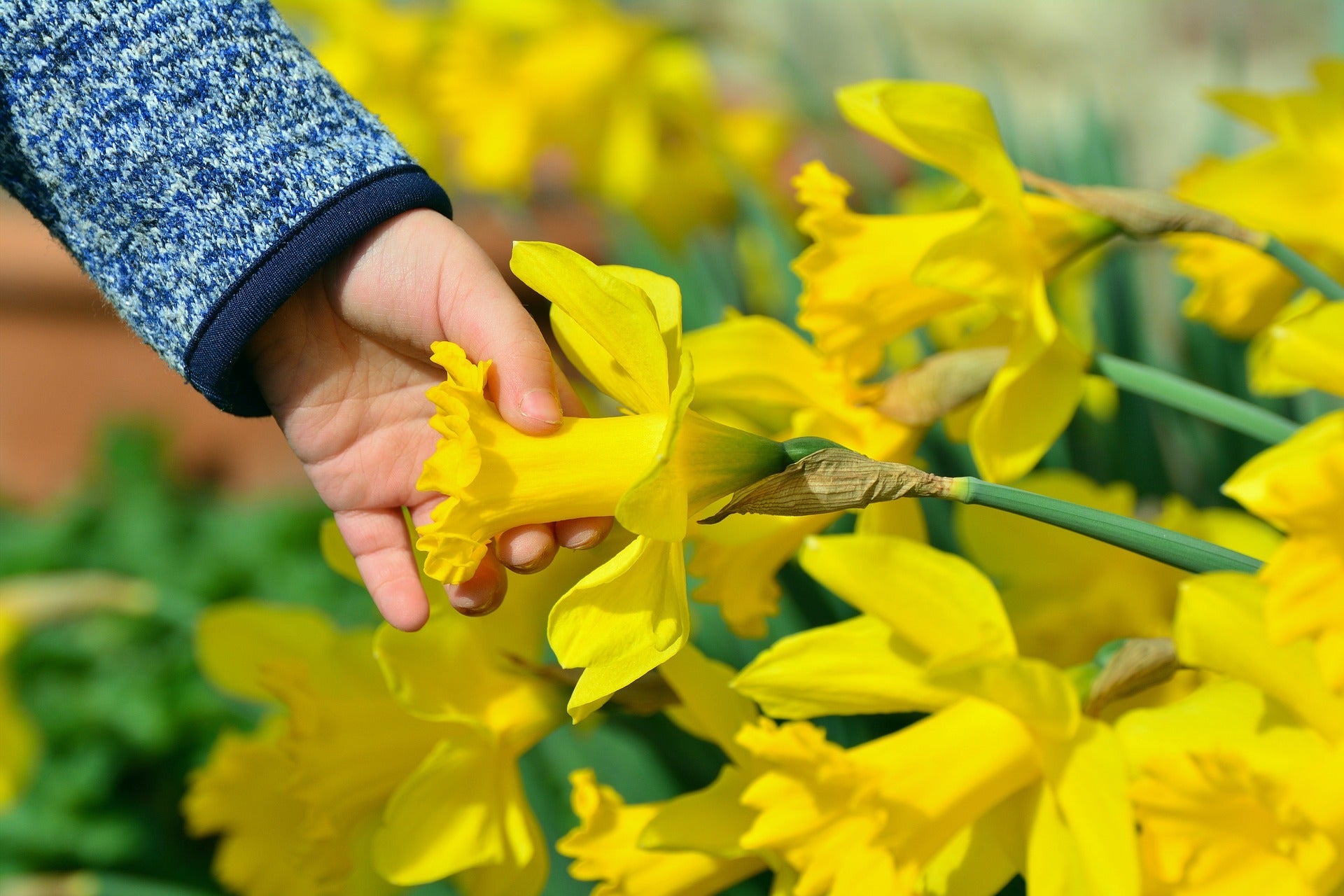
Trumpet daffodils are traditional-looking, with large flowers, one bloom per stem, and long trumpets at least as long as the petals. This group offers a wide variety of colours and shapes, and blooms in early to mid spring in almost any garden setting, including sun, shade, or grass. If you picture a classic yellow daffodil, this is almost certainly the one you are imagining.
Large-Cupped Daffodils
Large-cupped daffodils stand out with white petals and a golden-yellow cup with red edges. They are elegant and add extra interest to any garden, and often give more than one stem per bulb, each carrying a big flower. Varieties like California are reliable, widely available, and excellent for naturalising in grass.
Cyclamineus Daffodils
Cyclamineus daffodils are distinguished by their swept-back petals and long cups, resembling cyclamen flowers. They usually have one flower per stem and are early bloomers. Popular varieties include 'Elka' and 'Jetfire'. These are outstanding choices for pots and containers because of their compact size and early flowering date.
Jonquilla Daffodils
Daffodils divided into Jonquil daffodils produce small flowers, three or more per stem, with short wide petals held at right angles to cups. The cup is usually half the length of the petals. They are strongly fragrant and bloom in mid to late spring, preferring sunny locations and warm soil.
Double Daffodils
Double daffodils have multiple layers of petals and sometimes more than one cup, giving them a lush, full appearance. They can have one or more flowers per stem. Varieties such as 'Rip van Winkle' are favourites for their dramatic and showy blooms.
Poeticus / Pheasant's Eye
Double daffodils have multiple eye daffodils, feature a small, red-rimmed cup set against pure white petals. Daffodils are divided into Narcissus poeticus and its hybrids produce elegant flowers adorned with glistening white petals. Blooming in late spring, usually one flower per stem, these daffodils thrive in damp soil and look wonderful naturalised in tall grasses or next to deciduous trees.
When to Plant Daffodil Bulbs
The Autumn Planting Window
Daffodil bulbs should be planted in the fall, typically between September and November, before the ground freezes. The specific timing can vary depending on your climate, but the general rule is to plant in autumn when the soil has cooled but before hard frosts set in. In practice, most gardeners in Central Europe, including Hungary, will find October to be the sweet spot.
Daffodil bulbs should be planted when the soil temperature drops below 16°C but before it reaches freezing levels, as this window ensures the bulbs can establish roots without sprouting prematurely. You can use a basic soil thermometer from any garden centre to check this accurately.
What If You Miss the Window?
Do not panic. There are plenty of bargains to be had from November to January, with garden centres trying to sell remaining stock. Buying a discounted bag of daffodil bulbs and planting them in December is completely fine, just make sure the bulbs are firm and not showing signs of mould. You can plant daffodil bulbs as late as January or February, the bulbs may take longer to establish and flower, but they should catch up in years to come.
Pro Tip: According to a survey by Gardens Illustrated, 39 per cent of gardeners reported planting daffodil bulbs as late as January and still had them flower in spring. So if your bulbs are sitting on the shelf in December, get them in the ground; it is almost always worth trying.
Storing Bulbs Before Planting
If you have bought your bulbs early and cannot plant them right away, storage is simple. Daffodil bulbs should be stored in a dry, well-ventilated area. They should not be exposed to moisture or extreme heat while in storage, as this can lead to rot or premature sprouting. Keep them in a mesh bag or a container with ventilation to prevent mould from developing.
How to Plant Daffodil Bulbs Step by Step

Choosing Your Spot
Daffodils do best in full sun though they will grow in partial shade. They are generally not picky about soil, but good drainage is vital as they are susceptible to rot when kept too wet. Avoid low-lying areas where water collects after rain.
Daffodils grow best in full sun meaning at least six hours of direct sun per day. The more sun they get, the better, as more sun means more growth and blooms, but also means the soil will warm up faster in spring, giving you that flush of flowers sooner.
Planting Depth and Orientation
According to the Dutch growing guidelines, plant your daffodils so that their top (pointed end) is at least two times as deep as the bulb is high. Plant bulbs deeper in sandy soil than in clay.
As a practical rule: daffodils should be planted so the base of the bulb is about 15 cm below the soil surface; in light soils, bulbs may be planted about 20 cm deep. Always place the bulb with the pointed tip facing upwards.
Spacing
Tall daffodil varieties grow from large bulbs and can be planted in groups or drifts at a spacing of around 10 to 15 cm in borders or through grass. Dwarf daffodil varieties grow from smaller bulbs and can be planted at a spacing of around 5 to 10 cm apart.
Planting daffodils in clusters creates a very natural look and can help extend your bloom times. You can plant the same bulbs together, mix different daffodil varieties, or incorporate other companion plants such as tulips, hyacinths, or crocus.
Watering After Planting
Water daffodils thoroughly at the time of planting, then once a week for the next three weeks, as this is a crucial time when the plants are growing their first roots, or natural rain that keeps them moist. After the first few weeks, leave the plants alone until they begin to grow in the spring.
Caring for Daffodils Through the Season
Spring: While They Are in Bloom
Once your daffodils are flowering, the main job is simply to enjoy them. Water daffodils generously while the plant is blooming, and provide a handful of bulb fertiliser when shoots poke through the ground in early spring. Be sure to fertilise the soil around the plant, keeping the fertiliser off the foliage.
After Flowering: The Golden Rule
The single most important thing to understand about daffodil care is what to do once the flowers fade. When you remove the flowers, it is vital not to remove the foliage. This is where many gardeners make a crucial mistake, removing the foliage too early will actually steal future power from your bulbs.
Leave the foliage in place until it has turned yellow and withered, as this allows the plant to photosynthesize and store energy in the bulb. Once the leaves have died off, usually by sometime in July; you can then prune or chop off the dried foliage.
Deadheading Spent Flowers
Remove daffodil blooms as soon as they fade, otherwise the bulbs will exert considerable energy attempting to create seeds. However, remove only the bloom and stem, not the leaves. A simple pinch or clean snip at the top of the stem is all that is needed.
Dividing Overcrowded Bulbs
Daffodils are perennial bulbs which means they keep growing back every year. The bulbs will multiply under the soil, forming established clumps over time. Divide daffodils every three to five years, or whenever you notice that flowers are smaller in size or number. Divide the plant when the foliage is dying but still visible so you can see where to dig.
Common Beginner Mistakes to Avoid
-
Planting too shallow. If bulbs are planted too shallowly, they may not bloom properly. This is known as "blindness", while foliage will still emerge, few or no flowers will develop.
-
Cutting the leaves too soon. Producing abundant foliage but no blooms, referred to as "blindness", is commonly caused by premature leaf cutting, insufficient sunlight, overcrowding, or excessive nitrogen fertiliser.
-
Planting in a waterlogged spot. Daffodil bulbs are susceptible to rot if the ground is too wet, so it is important to keep an eye on your potential daffodil patch if it looks like the rain is falling too heavily.
-
Storing bulbs in plastic. Never store bulbs in closed plastic bags. Good air circulation is important for keeping them healthy, paper bags or crates with good ventilation are the right storage containers.
-
Using high-nitrogen fertiliser. Daffodils prefer a well-balanced fertiliser heavy on phosphorous and potassium. Too much nitrogen will cause them to grow all foliage and contribute very little to the health of the bulb.
Frequently Asked Questions
When is the best time of year to plant daffodil bulbs?
Daffodil bulbs should be planted in the fall, typically between September and November, before the ground freezes. The general rule is to plant them in autumn when the soil has cooled but before hard frosts set in. October is the ideal month for most gardeners in Central Europe. The BBC Gardeners' World growing guide confirms this window as standard best practice across temperate climates.
How deep should I plant a daffodil bulb?
As a general rule, plant the bulb at a depth of two to three times its own height, with the pointed tip facing upwards. Daffodils should be planted so the base of the bulb is about 15 cm below the soil surface. Going a little deeper is fine, going too shallow causes poor flowering.
Can I grow daffodils in pots?
Absolutely daffodils can thrive in containers. Use varieties that remain short and do not produce a foliage mass that is too large. With species like 'Tête à Tête' , but others include 'Paperwhite', '', 'Verdin' or 'Rip van Winkle'.
Why are my daffodils producing leaves but no flowers?
This is called "blindness" and is one of the most common issues beginner gardeners face. It occurs when bulbs lack sufficient energy reserves from last year, commonly caused by premature leaf cutting, insufficient sunlight, overcrowding, or excessive nitrogen fertiliser. The foliage is essential for generating food for the following year's flowers, so allow it to naturally turn yellow and wither.
How long do daffodils last in the garden without replanting?
Daffodils multiply year after year, and offer a wide range of flower shapes and colors. You may leave daffodils in the ground for between three to five years without disturbing them. If blooming does not happen one season, it would be best to move them to a new location. Once divided, they simply carry on for another multi-year cycle.
Daffodils are the ideal flower for anyone just starting their gardening journey. They ask very little: a well-drained spot, an autumn planting date, and the patience not to cut their leaves before summer. In return, they come back each spring, often bigger and bolder than the year before. Whether you source your bulbs locally or through a trusted specialist like Holland Kertészet, investing in good-quality bulbs at the outset makes an enormous difference to the display you enjoy come March and April.
Sources
-
How to Grow Daffodils, BBC Gardeners' World Magazine. Complete growing guide with seasonal advice. https://www.gardenersworld.com/how-to/grow-plants/how-to-grow-daffodils/
-
When to Plant Daffodil Bulbs, Gardenia.net. Detailed planting calendar and soil temperature guide. Daffodil bulbs should be planted
-
When to Plant Daffodil Bulbs: Plan for Spring Flowers in the Fall, Savvy Gardening. Practical autumn planting advice for home gardeners. https://www.almanac.com/plant/daffodils
-
A Guide to Daffodil and Narcissus Divisions, Gee Tee Bulbs. Breakdown of all 13 divisions with named cultivar examples. Double daffodils have multiple
-
How Deep Should I Plant Daffodils, Iowa State University Extension. University guidance on planting depth and spacing. https://yardandgarden.extension.iastate.edu/faq/how-deep-should-i-plant-daffodils
-
Spring Flowering Bulbs: Daffodils, University of Missouri Extension. Academic growing guide covering soil, spacing, mulching and light requirements. Jonquil refers to a specific kind
-
All You Need to Know About Daffodils and Narcissi, Farmer Gracy. Consumer guide to variety selection and seasonal succession planting. https://www.farmergracy.co.uk/blogs/farmer-gracys-blog/narcissus-guide-daffodils-narcissi
-
What to Do With Daffodils After Flowering, Rocky Hedge Farm. Post-bloom care guide covering deadheading, foliage, and dividing. https://www.rockyhedgefarm.com/what-to-do-with-daffodils-after-flowering/
-
How to Care for Daffodils After They Bloom, This Is My Garden. Step-by-step seasonal care instructions. https://thisismygarden.com/2024/04/daffodils-after-bloom/
-
Is It Too Late to Plant Bulbs?, Gardens Illustrated. Expert and reader survey on late planting success rates. https://www.gardensillustrated.com/garden-advice/how-late-plant-bulbs