
Blue – Wisteria sinensis
From Five Seeds to a Flowering Pergola
A friendly guide to sowing, training, pruning and enjoying Chinese wisteria in Hungary.
Come Into the Garden With Me…
Today, we're growing a plant that asks us to think in years rather than weeks: wisteria.
A sunflower races from seed to bloom in a single summer. Wisteria is different. It begins as a small seedling, becomes a woody climber, learns the shape of the support we give it, and then – when it is mature enough – rewards us with long hanging curtains of blue-violet flowers.
That slower rhythm is part of the pleasure. When you grow wisteria from seed, you are not simply filling a gap in the border. You are beginning a long-term relationship with a plant that may eventually become one of the largest and most memorable features in the garden.
Our Holland Kertészet packet is Wisteria Blue, Wisteria sinensis, with approximately five seeds. The packet recommends soaking the seeds for 24 hours, then sowing under glass in February–March or October–November. Mature Chinese wisteria is a very vigorous climber and can eventually make stems around 10 metres long.
For Hungary, wisteria can be an excellent choice. Established plants are hardy, love warm sunny summers, and can cope with winter cold when planted in a suitable position. But there are three things beginners must understand from the beginning: it needs a truly strong support, seed-grown plants can take several years to flower, and the seeds and pods are poisonous if eaten.
|
GOOD TO KNOW Growing wisteria from seed is a patient gardener's project. The seedling you raise this year may become the pergola-covering plant you enjoy for decades. |
1. Meet Wisteria
Wisteria belongs to the pea family, Fabaceae. That family relationship is easy to see once the flowers appear: each individual blossom has the familiar pea-flower shape, but dozens are arranged together in long hanging clusters called racemes.
Chinese wisteria
The plant in this book is Wisteria sinensis, commonly called Chinese wisteria. It is a woody, twining climber. Young stems wind around supports; older stems thicken into powerful rope-like trunks and branches.
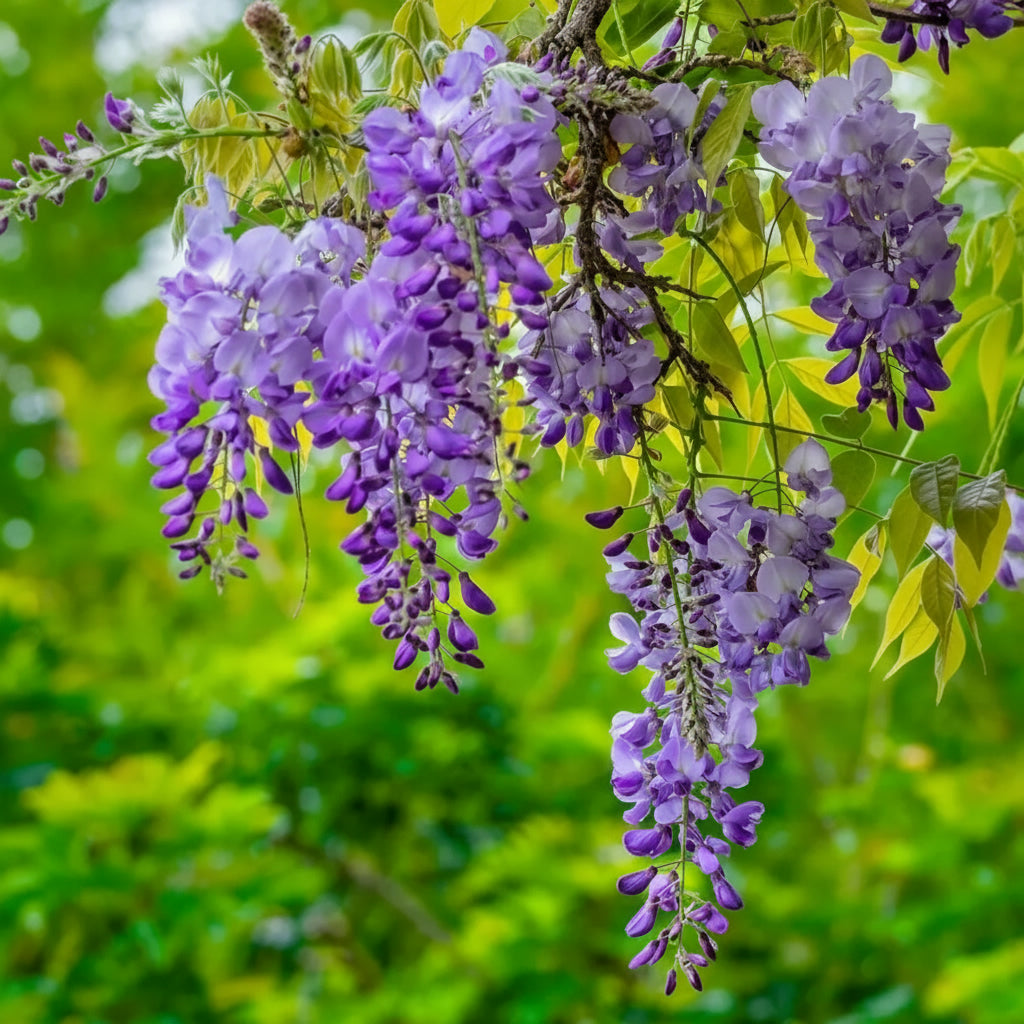
In spring, mature plants can cover themselves with blue-violet, lightly fragrant flower clusters. The leaves then create a generous green canopy through summer. Later, bean-like seed pods may develop.
How large can it become?
Very large. The packet describes stems up to about 10 metres. That does not mean every garden plant will instantly become 10 metres high, but it does mean we must plan for a permanent woody climber, not a delicate annual vine.
A mature wisteria can become heavy enough to damage weak trellis, gutters, drainpipes and flimsy fences. The support should be designed before the plant becomes large, because replacing it later is much harder.
|
THE FIRST BIG DECISION Do not ask only, ‘Where would the flowers look beautiful?’ Ask, ‘What structure can safely carry this plant twenty years from now?’ |
2. The Wisteria We Grow With You
Our Holland Kertészet packet is Climbing Flowers – Wisteria Blue.
At a glance: approximately 5 seeds; botanical name Wisteria sinensis; soak seed for 24 hours before sowing; sow under glass February–March or October–November; flowering on mature plants mainly in spring; vigorous woody climber; full sun preferred; hardy once established.
A very important seed-grown difference
A named grafted wisteria bought in a nursery is propagated from an adult flowering plant. A seedling begins life from zero. It must pass through a juvenile stage before it is capable of flowering.
That can take several years, and sometimes considerably longer. Seedlings can also vary from their parent plant, so flower colour, raceme length and eventual flowering performance are not guaranteed to be identical to a pictured mature specimen.
This is not a reason to avoid seed. It is simply a reason to choose seed for the right kind of gardener: someone who enjoys raising a plant from its very beginning and is happy to wait for the result.
|
BE PATIENT If you want flowers as quickly and predictably as possible, a grafted named wisteria is the faster route. If you want the experience of raising your own wisteria from seed, enjoy the journey as much as the eventual bloom. |
3. Choosing the Right Place in Hungary
Sun first
Wisteria flowers best in full sun. Aim for at least six hours of direct sun during the growing season. A warm south- or west-facing position can be excellent, provided the roots have enough moisture while the plant establishes.
A wisteria in deep shade may produce impressive leaves and long wandering shoots but disappoint you with few flowers. If flowering is the goal, sunlight matters.
Soil
Choose fertile but well-drained soil. Wisteria appreciates moisture while actively growing, but it does not want permanently waterlogged roots. Heavy Hungarian clay can be improved by planting slightly raised and ensuring water can move away from the root zone.
Shelter
An established plant is hardy, but very exposed sites can be harder on young shoots and early flowers. A sheltered wall, sturdy pergola or protected garden structure often gives the best combination of warmth, sun and wind protection.
Keep it away from vulnerable structures
Do not allow stems to disappear behind roof tiles, into gutters, around drainpipes or through weak wooden panels. Young shoots look harmless. Older woody stems can become astonishingly strong.
4. Sowing Wisteria From Seed
Step 1 – soak
Place the seeds in room-temperature water for about 24 hours before sowing. The hard seed coat benefits from this soaking period and the seed often swells slightly.
Step 2 – sow individually
Use small pots with a free-draining seed compost. Sow each seed separately so the young roots do not become tangled. Cover by roughly 1–2 cm and water gently.
Step 3 – warmth and patience
Keep the pots warm and bright. Around 18–22°C is a practical germination range. Keep the compost evenly moist but not saturated. Germination may take a few weeks and not every seed will necessarily germinate at the same time.
Step 4 – light immediately after germination
Once a shoot appears, give it plenty of light. Wisteria seedlings can stretch quickly in weak indoor light. A bright cool windowsill or protected greenhouse is better than a very warm dark room.
The packet gives two useful sowing windows: February–March or October–November under glass. For a beginner in Hungary, late winter sowing is often easier because increasing spring light helps the seedlings develop strongly.
|
DON’T PANIC Five seeds do not mean five identical seedlings appearing on the same morning. Give the pots time and keep conditions steady rather than repeatedly digging to see what is happening. |
5. Caring for the Young Plant
Potting on
When roots fill the small pot, move the seedling into the next pot size rather than immediately into a huge container. Use a good-quality potting mix and include a cane or small support so the young stem has somewhere to climb.
Hardening off
Before a spring-raised plant goes outdoors permanently, acclimatise it gradually. Put it outside for increasing periods during mild weather, then bring it back under protection if nights turn cold.
When to plant outside
Young seedlings are more vulnerable than established woody wisteria. In Hungary, planting in late spring after severe frost risk has passed is the safest beginner approach. Autumn planting can also work for a well-established potted plant in a sheltered position, but give it time to root before hard winter weather.
Watering the first years
A mature wisteria is much tougher than a new one. During the first one or two growing seasons, water deeply during dry spells. We want roots to explore a large volume of soil, not remain dependent on a tiny damp patch at the surface.
6. Building a Support That Will Last
This chapter may be more important than the chapter about flowers.
Wisteria becomes heavy. A mature trunk can be as substantial as a small tree, and side branches continue thickening for years. Use metal wires fixed securely into masonry, a genuinely strong pergola, or another structure designed for a permanent woody climber.
Training the framework
Choose one or a few strong main stems and guide them where you want the permanent framework to grow. Tie them loosely with soft ties. Never use thin wire directly around a stem; the stem will thicken and the wire can cut into it.
As the plant reaches the top of a support, guide branches horizontally. Horizontal trained wood helps create many short flowering side shoots later.
Keep access for pruning
Do not build a training system that becomes impossible to reach. Wisteria needs regular pruning, so make sure you can safely access the main framework every summer and winter.
|
GROW WITH US Imagine the mature plant before you tie the first shoot. A little planning now creates the shape you will prune and enjoy for many years. |
7. The Two-Prune Wisteria Rhythm
Once your wisteria is growing strongly, pruning becomes the secret to keeping it controlled and encouraging flowering wood. The classic system uses two main pruning periods each year.
Summer pruning – July to August
After the main spring growth has extended, shorten long whippy side shoots to about five or six leaves from the main framework. This keeps the plant from swallowing the garden and allows more light to reach the developing wood.
In Hungary this summer pruning often falls during hot weather, so choose a cooler morning and avoid damaging the permanent framework.
Winter pruning – January to February
When the leaves have fallen and the structure is easy to see, shorten those same side shoots again, usually to two or three buds from the main stem. These short spurs are where flower buds can develop.
Do not remove the main structural branches you are intentionally training. Think of winter pruning as refining the framework, not starting again from the ground.
|
THE FLOWERING SECRET Long uncontrolled whips make lots of plant. Short, well-managed spurs help turn that energy into a framework capable of carrying flowers. |
8. Feeding, Watering and Encouraging Flowers
Do not overfeed with nitrogen
Wisteria belongs to the pea family and does not need endless high-nitrogen feeding. Too much nitrogen can encourage vigorous leafy growth at the expense of flowers.
If your soil is poor, a balanced feed in spring can help. Once mature, many garden-grown plants need surprisingly little fertiliser.
Water during bud development and drought
Established wisteria is robust, but prolonged spring and summer drought can stress the plant. Deep watering during very dry periods is especially worthwhile for young plants and for specimens growing against walls where rainfall may not reach the roots effectively.
Why is my wisteria not flowering?
For a seed-grown plant, youth is the first explanation. It may simply not be mature enough. Other causes include too much shade, too much nitrogen, severe drought, or pruning that continually removes the short flowering spurs.
Do not expect pruning tricks to make a juvenile seedling flower instantly. First grow a healthy framework. Flowering comes with maturity.
9. Flowers, Pollinators and the Garden Experience
When a mature wisteria finally flowers, the effect is extraordinary. The racemes hang beneath the framework like chandeliers. On a pergola, you can stand underneath them. Against a wall, the flowers create vertical curtains of colour.
The flowers can attract bees and other pollinating insects. Their fragrance is often most noticeable on warm still days.
Good companions
Because wisteria eventually creates strong overhead structure, keep the planting beneath it comparatively simple. Spring bulbs, shade-tolerant groundcover beneath a mature pergola, or pots that can be moved as light conditions change all work well.
Avoid planting another very vigorous climber into exactly the same support. One mature wisteria is usually enough architecture for a small garden.
A note about the pods
After flowering, bean-like pods can form. They may look tempting to children because they resemble edible legumes. They are not edible. The seeds and pods are poisonous if swallowed.
10. Safety Around Wisteria
Wisteria is an ornamental plant, not a food crop. All parts should be treated as non-edible, with particular care around the seeds and pods.
If children or pets use the garden, remove pods before they mature and fall where they may be picked up. Wear gloves if your skin is sensitive when pruning and wash hands after handling plant material.
Do not use wisteria flowers, seeds, pods or leaves in homemade food, tea or remedies. The beautiful pea-family appearance is exactly why it is important to label the plant clearly.
|
SAFETY FIRST The pods may look like beans, but wisteria is not an edible pea. Keep seeds and pods away from children and pets. |
11. Common Problems
Lots of leaves, no flowers
On a young seed-grown plant, wait. On an older plant, check sunlight, nitrogen feeding and pruning. Mature flowering wood needs light and a stable spur system.
Long shoots everywhere
This is classic wisteria behaviour. Carry out the summer prune and keep training the permanent framework where you want it.
Yellow leaves
Occasional yellowing is not automatically a disaster. Check watering first. In very alkaline soil, nutrient availability can also become a problem. Improve soil conditions rather than repeatedly adding random fertilisers.
No germination
Make sure the seed was soaked, the compost stayed gently moist, and temperatures were warm enough. Give the pots time. With only a few seeds, steady conditions matter more than constant interference.
Weak or broken support
Act early. Move or retrain young growth before the stem becomes woody. Never wait for a failing trellis to be hidden beneath a mature wisteria.
12. A Simple Wisteria Calendar for Hungary
JANUARY–FEBRUARY Winter prune established plants to two or three buds on the short side shoots. February is also a useful protected sowing month.
MARCH Continue sowing under glass. Check supports and ties before vigorous spring growth begins.
APRIL Mature plants begin active growth and, when old enough, may develop flower racemes. Water if spring is unusually dry.
MAY Main flowering season for established plants. Plant hardened young wisteria outdoors once conditions are safe.
JUNE Train new shoots and keep young plants watered during dry weather.
JULY–AUGUST Summer prune long side shoots to about five or six leaves. Deep-water during prolonged drought.
SEPTEMBER Continue training the permanent framework. Reduce high-nitrogen feeding.
OCTOBER–NOVEMBER The packet allows protected autumn sowing. Mature plants lose their leaves and the structure becomes visible again.
DECEMBER Inspect supports and plan winter pruning. Remove any loose pods where children or pets may reach them.
13. Your Wisteria Cheat Sheet
• Botanical name: Wisteria sinensis. • Product: Wisteria Blue, approximately 5 seeds. • Type: hardy woody climber. • Eventual size: potentially around 10 m of growth. • Position: full sun for best flowering. • Soil: fertile, moist but well drained. • Seed preparation: soak 24 hours. • Sow: February–March or October–November under glass. • Support: permanent and very strong. • Main pruning: summer and winter. • Flowering from seed: may take several years. • Safety: seeds and pods are poisonous if eaten.
|
IF YOU REMEMBER ONLY FIVE THINGS Give it sun. Build a strong support. Soak the seed before sowing. Prune twice a year once established. And be patient – seed-grown wisteria is a long-term garden story. |
One Last Walk Around the Garden
We began with a packet containing only a handful of seeds. That seems almost absurd when you imagine what one successful seedling can eventually become.
At first there is only a pot, a swollen seed and one green shoot looking for something to climb. Then there is a cane. A stronger support. A first woody stem. A branch trained across the top of a pergola. Another year of pruning. Another year of waiting.
And then, one spring, you notice something different among the buds. The first flower raceme begins to lengthen. Blue-violet blossoms open one after another, and the plant you once held in a small pot is suddenly hanging flowers above your head.
That is why wisteria belongs in this series. Gardening is not always about instant results. Sometimes the most memorable plants are the ones that teach us how much can happen when we keep showing up, season after season.
Until then, train the young stems, keep the roots watered, build the support properly and enjoy watching the plant become itself.
And whenever you're ready to grow something new…
Come into the garden with me.