
From Tiny Seeds to a Summer Full of Sunshine
A friendly guide to sowing, growing and enjoying African daisies.
Come Into the Garden With Me…
Today, we're growing African daisies.
And this time, I'd like to introduce you to a flower that seems particularly well suited to the way our Hungarian summers are changing.
It likes sunshine. Actually, 'likes' may be putting it mildly. African daisies love sunshine.
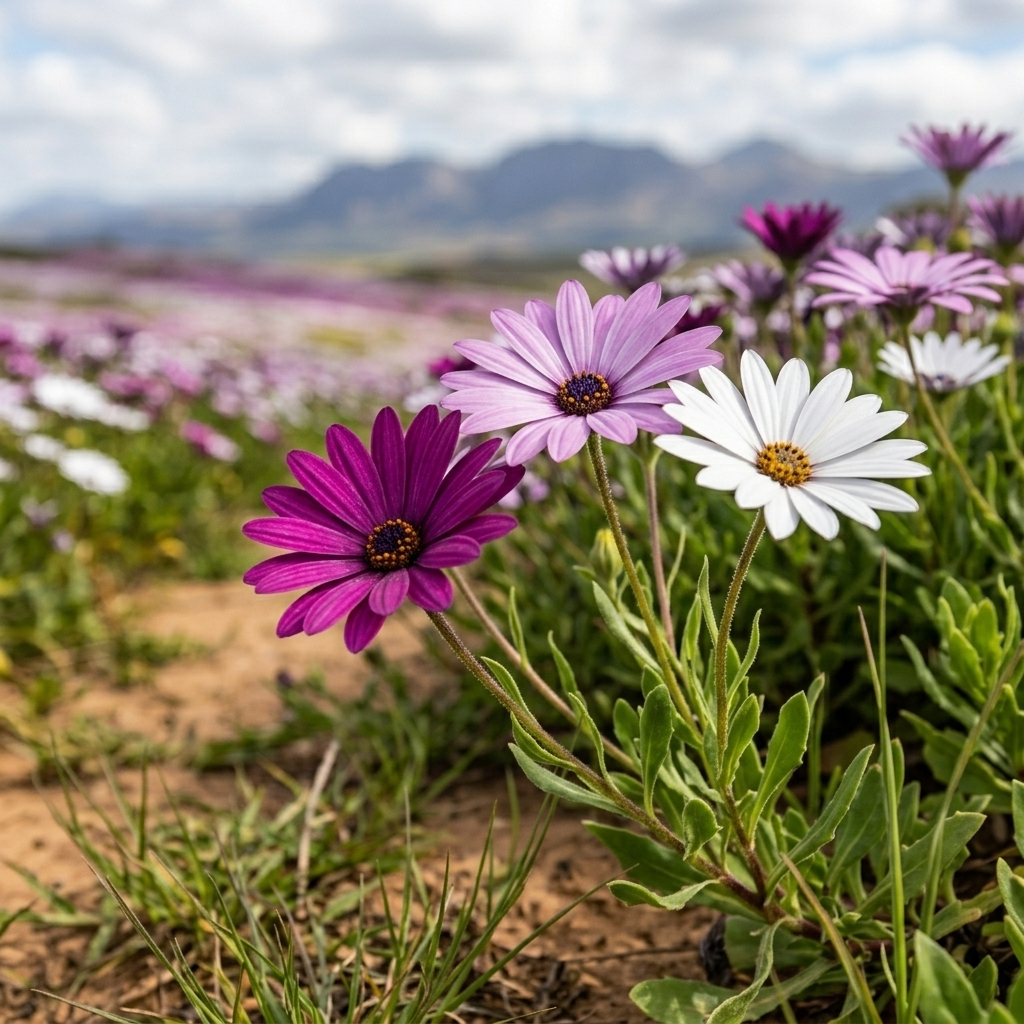
Give them a bright, warm position and they'll reward you with cheerful daisy-like flowers in colours that can range from white and soft pink to purple, yellow and orange.
And when the sun disappears? Something rather charming happens. Many African daisy flowers partially close when the light fades, only to open again when the sunshine returns. It's almost as though the flowers themselves are checking the weather.
For those of us gardening in Hungary, African daisies have another advantage. Once established, they're quite comfortable with warmth and relatively dry conditions.
So unlike our ranunculus and anemones, which we're trying to coax into flower before serious summer heat arrives, African daisies are waiting for the sunshine. This is their season.
There is one important difference, though. African daisies originate from southern Africa, and most of the types we grow for summer colour are not reliably hardy through a Hungarian winter.
So we'll generally treat them as annual summer flowers, even though botanically some types can live for several years in warmer climates.
But let's not worry about winter yet. We haven't even opened the seed packet.
We'll go through everything together: which African daisy to choose, when to sow, how to raise the seedlings, where to plant them, how to keep them flowering and what to do when something doesn't look quite right.
Ready? Let's find the sunniest place in the garden.
1. Meet the African Daisy
Here's where we need to clear up a little gardening confusion.
'African daisy' is a common name used for several daisy-like plants from southern Africa. The African daisies we're interested in here are Osteospermum, the colourful sun-loving plants widely grown in containers, borders and summer displays.
You may also hear them called Cape daisies.
And if you've seen them at a garden centre, you probably remember the flowers. They have that familiar daisy shape - a central disc surrounded by petals - but the colours can be anything but ordinary.
Some have white petals around a dark blue centre. Others are purple, pink, yellow, orange or combinations of several shades. Some varieties even have petals that change colour from the centre outward.
A flower that follows the light
One of the most noticeable things about many African daisies is the way their flowers respond to light. On a bright, sunny day they're wide open. When clouds arrive or evening approaches, the flowers may begin closing.
Don't panic. Nothing is wrong. That's simply part of their natural behaviour. The next sunny morning, they'll open again. I rather like that. It's a flower with opening hours.
Annual or perennial?
Botanically, many Osteospermum are tender perennials or subshrubs. In a mild climate, they may live for several years. In Hungary, it is easiest to think of them as summer annuals unless you deliberately overwinter a suitable plant somewhere frost-free.
|
GOOD TO KNOW African daisies and Hungarian summer can make a very good partnership. Sunshine + warmth + good drainage = happy African daisies. |
2. Finding the Sun
Before we sow anything, let's go outside. We're looking for one thing above all: sunshine.
African daisies perform best in a bright, sunny position. If you put them somewhere too shady, the plants may grow but flowering can be disappointing. And that's rather missing the point. We're growing these for flowers. Lots of them.
A sunny Budapest balcony can become seriously hot in July. A south-facing terrace near Pecs can feel almost Mediterranean. A garden on the Great Hungarian Plain may experience long periods of strong sun and dry weather.
African daisies are much more comfortable with those conditions than many traditional bedding plants. But heat tolerant doesn't mean indestructible.
A plant growing in the ground has access to a much larger reservoir of moisture than one growing in a small pot on a balcony. So location still matters.
African daisies don't like sitting permanently wet. Choose well-drained soil. If your garden soil is heavy clay, improve the structure before planting. Containers are excellent, provided they have proper drainage holes.
What kind of soil?
They don't need extraordinarily rich soil. Ordinary fertile, well-drained garden soil is perfectly suitable. If the soil is extremely rich and heavily fed, you may encourage lots of leafy growth rather than the compact, flower-filled plant we're after.
|
A COMMON MISTAKE Planting an African daisy in shade because the label says it can tolerate some shade. Can it survive? Perhaps. Will it give you the flower display you imagined? Probably not. Give it the sunshine. |
3. Which African Daisy Shall We Grow?
Now for the enjoyable part. Choosing.
African daisies can be found in a wonderful range of colours: white, cream, yellow, orange, pink, mauve, purple, and all sorts of combinations in between.
Some flowers have dramatically dark centres. Some have a ring of colour around the central disc. Some petals seem to change shade as they move outward. This is not a boring daisy.
The African Daisies We Grow With You
At Holland Kerteszet, we currently have two African Daisy choices: African Daisy Mixed - 0.4 g and African Daisy Akila - 10 seeds.
African Daisy Mixed
If you enjoy a little surprise, choose the Mixed packet. A mixture gives you the pleasure of not knowing exactly what every plant will look like until it flowers.
You sow a tray of tiny seeds, raise the plants together, plant them out, and then one morning the first flower opens. Perhaps it's purple. The next is white. Then pink. Then another shade you weren't expecting.
A mixture works beautifully if you want a cheerful, informal summer display in a sunny border, a large container, a cottage-style garden or a colourful terrace display.
African Daisy Akila
Then we have Akila. Akila belongs to a modern Osteospermum series bred for good garden performance, compact growth and generous flowering.
This is the one I'd look toward when you want a slightly more deliberate, polished effect. Akila can be particularly useful for pots and containers because African daisies naturally lend themselves to sunny spaces around the house where we actually see them every day.
|
GROW WITH US These are the African daisies we've chosen for Holland Kerteszet. Perhaps yours will spend summer on a sunny Budapest balcony, in a border near Lake Balaton, or in terracotta pots outside a house in Gyor-Moson-Sopron. The conditions may differ, but the goal is the same: understand what the plant wants, then give it the best version of that in your garden. |
4. Let's Sow
Open the packet. This is where our summer begins.
Because African daisies dislike frost, I like giving them a protected start in Hungary. Sow indoors or under protection in late winter to spring so the young plants have time to develop before they're moved permanently outside.
Fill a clean seed tray, module tray or small pots with a fine seed-starting compost. Moisten the compost before sowing. We want it evenly moist rather than soaking wet.
Sow the seeds according to the packet directions and cover them lightly. Then place the tray somewhere warm and bright.
During germination, don't allow the compost to dry completely. But don't keep it permanently saturated either. Use a gentle watering method.
Once seedlings appear, good light becomes extremely important. Too little light gives you pale, stretched seedlings leaning desperately toward the nearest window. We want short, sturdy young plants.
|
DON'T PANIC Not every seed germinated? That's normal. Seeds are living things, not factory-made screws. Some germinate quickly, some take longer, and some don't germinate at all. We don't need every seed - we need enough healthy plants to fill our sunny corner with flowers. |
5. From Seedling to Garden
The tiny seedlings are growing. Real leaves appear. Roots begin filling the compost. And suddenly that tray on the windowsill starts looking rather crowded.
Once seedlings are large enough to handle comfortably, move them into individual pots or modules if necessary. Handle them gently. Hold a seedling by a leaf rather than squeezing its delicate stem.
Before planting permanently outdoors, wait until the danger of significant frost has passed.
And even then, don't take a plant that has spent its entire life indoors and suddenly put it outside in blazing sunshine and wind for twelve hours. We need to harden it off.
For a week or two, gradually introduce the plants to outdoor conditions. Start with a sheltered position for a few hours, then gradually increase the time they spend outside.
Choose that sunny, well-drained position we found earlier. Water them in, and for the first few weeks keep an eye on moisture while their roots establish.
|
WHAT I WOULD DO If this is your first year growing African daisies, put a few in the garden and a few in pots. At the end of summer, compare them. Which flowered more? Which needed more water? Which position did they prefer? Your own garden can teach you more in one summer than ten plant labels ever will. |
6. Summer Has Arrived
Now we're entering African daisy territory. The sun is stronger. Days are long. Hungarian summer has arrived.
Once established, African daisies can tolerate relatively dry conditions. But don't interpret that as: never water them.
Plants in containers need particular attention. On a hot Budapest balcony in July, a pot can dry astonishingly quickly. Check the compost with your finger. If it's dry below the surface, water thoroughly, then allow excess water to escape.
African daisies growing in containers can benefit from occasional feeding during the flowering season. Use a suitable flowering-plant fertiliser according to its instructions.
Remove faded flowers regularly. This keeps the plant looking fresh and encourages it to put energy into producing more flowers rather than seed.
On cloudy days, in the evening or during dull weather, many varieties partially close. Don't panic. Wait for the sun. They'll probably open again.
7. When Something Goes Wrong
African daisies are relatively straightforward plants. But no garden is completely problem-free.
Lots of leaves, not many flowers? First ask how much sun the plant is getting. Then think about feeding: too much nitrogen can encourage foliage at the expense of flowers.
The plant is wilting? Touch the soil. Don't guess. If the soil is bone dry and the plant is growing in a container on a 35 C afternoon, water thoroughly. If the soil is soaking wet, adding more water is clearly not the answer.
Yellow leaves can indicate overly wet soil, poor drainage, nutrient problems or general plant stress. Look at the entire plant and its growing conditions rather than diagnosing it from one leaf.
Tender new growth may attract aphids. Check stem tips and developing flower buds. Small infestations are much easier to manage than large ones.
Young plants can also be vulnerable to slugs and snails, especially after damp nights. Once plants are larger and established, they generally become less tempting than soft little seedlings.
|
A COMMON MISTAKE Seeing a wilting plant and immediately giving it water. Always check the soil first. Sometimes wilt means 'I'm thirsty.' Sometimes it means 'My roots are sitting in wet soil and can't function properly.' The plant looks similar. The solution is completely different. |
8. Flowers, Flowers, Flowers
This is why we came.
One flower opens. Then another. Then suddenly your little plant is covered in colourful daisies.
On a sunny morning, African daisies can completely transform a terrace or flower bed.
This isn't really a flower I would hide in the farthest corner of the garden. Put it somewhere you spend time: beside the terrace, near the garden table, along the path, on the balcony or near the front door.
African daisies work beautifully with other sun-loving summer plants such as lavender, salvia, verbena, ornamental grasses, gaura and marigolds.
Open daisy-like flowers can also provide accessible food for visiting insects. So while you're admiring your African daisies, take a moment to see who else has discovered them.
|
TRY THIS Plant three or five African daisies of the same colour together rather than scattering individual plants everywhere. You'll create a much stronger block of colour. Then repeat that colour somewhere else in the garden. Suddenly your planting starts looking intentional. |
9. When Autumn Arrives
Eventually, even the longest Hungarian summer ends. September arrives. The light changes. Nights become cooler.
But don't remove your African daisies too quickly. They can continue flowering surprisingly late if conditions remain favourable. Keep deadheading, keep watering when necessary, and enjoy every last flower.
African daisies are not reliably hardy through normal Hungarian winters. For most gardeners, the simplest approach is to treat them as annuals.
A favourite container plant can potentially be moved to a bright, cool, frost-free place before severe cold arrives. Reduce watering considerably during winter and see how it looks when spring returns.
Depending on the type, you may also be able to collect mature seed from flowers allowed to finish naturally. Seed collected from modern hybrids may not produce plants identical to the parent, which can be part of the fun.
10. Your African Daisy Cheat Sheet
1. Choose your seeds. At Holland Kerteszet, look for African Daisy Mixed or African Daisy Akila.
2. Start under protection. Sowing before outdoor conditions are reliably warm gives plants a useful head start.
3. Give seedlings good light.
4. Keep the seed compost moist, not waterlogged.
5. Pot young plants on when they need more room.
6. Don't rush them outside. African daisies aren't friends with frost.
7. Harden seedlings off gradually.
8. Plant after serious frost danger has passed.
9. Choose sunshine. Lots of it.
10. Make sure the soil drains.
11. Water young plants while they establish.
12. Once established, don't overwater.
13. Check containers frequently during hot Hungarian weather.
14. Feed container plants sensibly during flowering.
15. Don't overfeed garden plants.
16. Deadhead regularly.
17. Don't panic when flowers close during dull weather.
18. Check for aphids and other pests while you wander through the garden.
19. Enjoy flowering into autumn for as long as the weather allows.
20. Treat plants as annuals - or try overwintering one just because you can.
If You Remember Only Five Things…
1. African daisies want sunshine
Don't make them negotiate for it. Give them your sunny spot.
2. They like warmth but still need water while establishing
Drought tolerance comes with maturity. A tiny seedling isn't a desert plant.
3. Drainage matters
Water thoroughly when necessary. Then let the excess escape.
4. Keep removing old flowers
Deadheading is one of the easiest ways to keep the summer display looking fresh.
5. Hungarian winter is the problem, not Hungarian summer
Think of African daisies as wonderful summer guests. They arrive, they fill the garden with colour, and when winter comes, we usually say goodbye. Next spring, we invite them back.
One Last Walk Around the Garden
Do you remember where we started? With seeds. Tiny, quiet little things in a packet.
We sowed them. Waited. Saw the first green shoots. Gave them light. Potted them on. Carried them outside. Then back inside. Then outside again.
We waited for the Hungarian spring to stop threatening us with frost. And finally, we planted them.
Summer arrived. The days became longer. The sun became stronger. And our African daisies began doing exactly what we'd hoped. They flowered. And flowered. And flowered.
Perhaps you grew the Mixed packet and found yourself waiting every morning to see which colour would open next. Perhaps Akila became the star of your terrace. Perhaps one plant did brilliantly while another sulked in a corner - and now you know that corner isn't sunny enough.
That's gardening. Success teaches us. Failure teaches us. And occasionally the plant does something completely unexpected and teaches us something we weren't even looking for.
Next year you'll know where to put your African daisies. You'll know when to sow them. You'll recognise when they need water. You won't panic when the flowers close on a cloudy afternoon.
And you'll know that when July arrives and the Hungarian sun is blazing down on the garden, this is one flower that isn't wishing it were somewhere else.
A garden doesn't need hundreds of different plants. It needs plants you enjoy coming outside to see. And if a flower opens every morning when the sun appears, that's a pretty good reason to walk outside with your coffee.
Enjoy your African daisies. Enjoy the sunshine.
And when you're ready to sow something else…
Come into the garden with me.